July 7, 2016
I was abruptly torn
from a thin veil of sleep by concentrated lights and shouting voices. They were security guards, shining flashlights directly in my eyes and demanding I get up. My bones ached into movement as I peeled myself off the solid concrete of an underground bus terminal, my solid white outfit sullied by oil and grime. Just 12 hours earlier, I’d had a warm bed in a cushy hotel room. Now I needed to find another place to lie on the ground. I needed to squeeze a bit more rest in; I would be running for my life in just 4 hours.
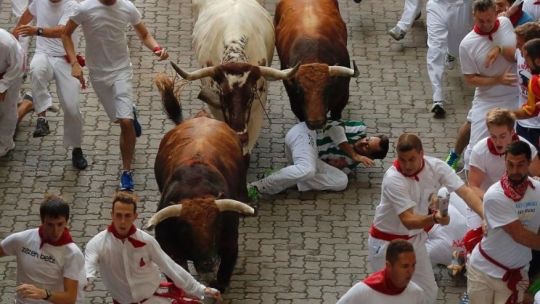
The Festival of San Fermin, more popularly known as the running of the bulls, is a week-long festival that takes place each July in Pamplona, Spain. Made popular to Western culture by Hemmingway’s “The Sun Also Rises”, the festival is frequently associated with vicious gorings and controversial bullfights. I was in Barcelona when I discovered through word of mouth that the festival would be taking place in a few days. Naturally, I had to do it.
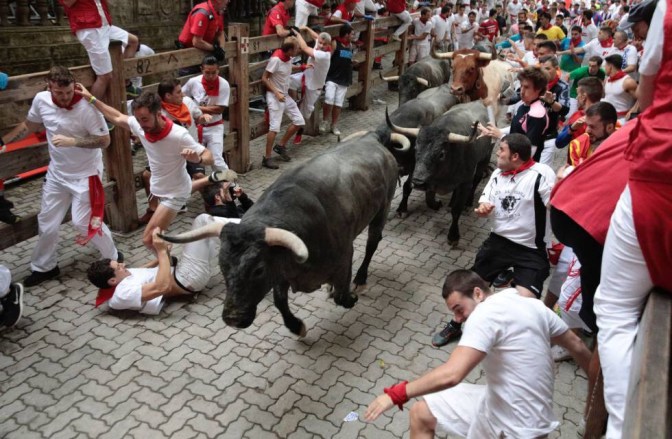
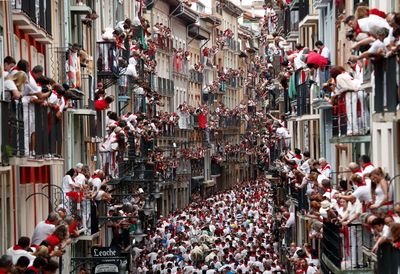
I spent the few nights I had before the festival studying videos from past years and formulating a strategy for the chaos. The course extends a total of 800 meters and winds itself through the cobblestone streets of Pamplona. Wooden fences are erected at various intersections to ensure the bulls remain on course and won’t be released into the city, and the spectators. Upon their release, the bulls will swiftly make their way uphill through a narrow alley and into a large city square. From there they continue downhill into a 90-degree turn referred to as “La Cuerva.” Often the bull’s momentum leads them sliding into this corner, potentially slamming runners into the stone buildings and wooden doors. Following “La Cuerva” the course forms a 200-meter straightaway with tall buildings rising on both sides, leaving no escape routes. After this straightaway is the home stretch; one last turn leads downhill to an entryway that funnels into a large bullfighting arena. The entrance of the arena often acts as a bottleneck that causes runners to pile up, rendering them as bowling pins for the bulls on their heels. Making it into the stadium doesn’t mean you’re home free either, because the bulls enter right behind you! Runners need to part in either direction, allowing the bulls to run straight ahead into the middle of the arena while the finishers (survivors?) clamor over the protective walls at the edge of the arena.
I resolved to start running in the town square near the start of the course. It was the widest, and arguably safest, part of the course. I planned to dart through as much as the square as possible before quickly splitting off and leaping through one of the large wooden fences that would be set up to contain the beasts before they descended into “La Cuerva.” The next day, with a paper-thin plan in hand, I hopped on the first train to Pamplona and spent the four-hour journey thinking “what the hell am I doing?”
Pamplona met me with a hot, empty train station, several aged brick buildings, and a long, green park with magnificent views across the city. I enjoyed the serenity, the calm before a storm whose clouds grew darker with each hour. However, the anxiety that had perniciously crept over me began to loosen its hold as I approached the town center. It was impossible to ignore the jovial tone that permeated the decorated stone streets. The crowds were thick, the music was loud, and sangria poured freely through the town; it flowed down the throats of festival goers, into the white fabric of their outfits, and ran in bright streams between the cobblestones on each and every block. Let me tell you, if you don’t go to San Fermin to risk your life running, surely go for the fiesta. Every day for a week straight, the entire town and its myriad visitors take to the streets for live music, costumed parades, and sangria… lots of sangria. People literally spray you with hoses of the stuff.
After dropping off my heavy backpack at a bus stop concierge, I spent the rest of the afternoon wandering the streets of Pamplona and partaking in the festivities. During the Festival of San Fermin everyone you meet is in such a great mood and the atmosphere is unlike anything else. Everyone is a new friend, even if they are too foreign, or drunk, to hold fluent conversation. I attempted to scout out the course I would be running in the morning but almost every street was wall to wall chaos, making all but floating in the sea of revelry impossible. By nightfall, the festival goers had gathered about a large field to mingle and socially sip from buckets of sangria while awaiting a conclusive firework show. The show was adequately entertaining and ended around midnight. While I wanted to continue along with the party, I also figured showing up to run from deadly wild animals at 8AM tired and hungover probably wouldn’t be the best move. Off to my comfy hotel room I went…
I wish.
The Festival of San Fermin is a massively popular event, so accommodations aren’t cheap and they sell out months in advance. This leaves thrifty, last minute travelers like myself technically homeless for their time in Pamplona. Prior to arriving, I had heard that it’s not uncommon for loads of people to just sleep in one of the many parks scattered throughout the city. However, some friends I had made during the event recommended the underground bus stop as the best place to sleep and they invited me to join them for the night. With no better options I begrudgingly accepted, knowing I at least had a sleeping bag in by pack still stored at the concierge down there. Thinking I’d hit rock bottom about to sleep on the ground in a subterranean bus station nearly 6,000 miles from home, I was surprised to find it packed down there. People dressed in the white and red colors of San Fermin lined the walls of the station; the lucky ones slumped over on limited benches. The concierge which held my pack was closed so I was reduced to sleeping bareback on smooth, oily concrete with a half empty plastic water bottle as my pillow. Between the dismal conditions, security waking and relocating us, and the systematic arrival and departure of loud buses throughout the night, I may have grasped an hour of sleep tops.
At 0530 I “woke up.” I’d really just been lying uncomfortably with my eyes shut for too long. I was cold, stiff, and exhausted; not feeling in any way ready to sprint hundreds of meters away from perceived certain death. The scene emerging from the bus station was dank. It had rained all night, leaving people desperately huddled under awnings, still drunk from the night before and looking more miserable than I could imagine. Suddenly the night underground didn’t seem so bad. I spent some time under the bus station awning stretching my legs and waking up. Then, an hour early, I followed the droves of fellow runners to the beginning of the course.
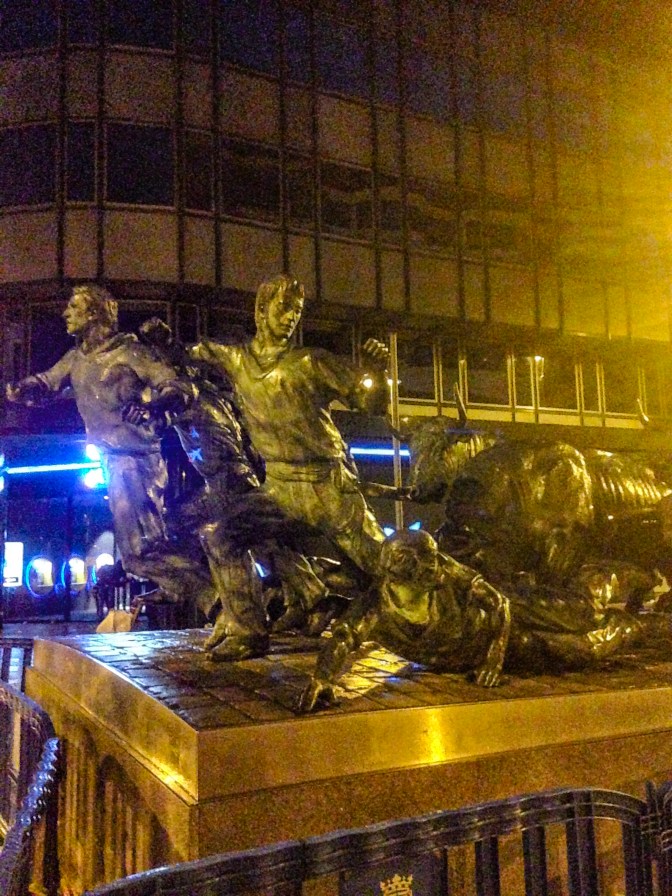
The crowd can walk the course all morning long; however, 10 minutes before they release the bulls, the local police will remove non-runners that may have found themselves on the wrong side of the fence. Then the participants can walk or jog down the street to choose their starting position, locked in by wooden enclosures, stone walls, and a sea of spectators. Finally, two rockets are fired. The first signifies that the corral containing the bulls has been opened and the second lets everyone know that all the bulls have left the corral and are loose in the street.
Ensue chaos.
Now, although 12 animals are released, only 6 of them are the dangerous fighting bulls; the other 6 are bell oxen. Their job is to help guide the bulls to the stadium at the end of the course. In theory the whole thing should run smoothly, and sometimes it does. Bulls are herd animals and their instinct is to follow the stampede of bell oxen, and people, from their corral all the way to the stadium, 826 meters in total. That’s why it’s referred to as running “with” the bulls, not “from” the bulls. Unfortunately, this is not always the case and if a fighting bull becomes separated from the herd, either by slipping on the slick cobblestones or by a foolish runner distracting it, things can turn deadly.
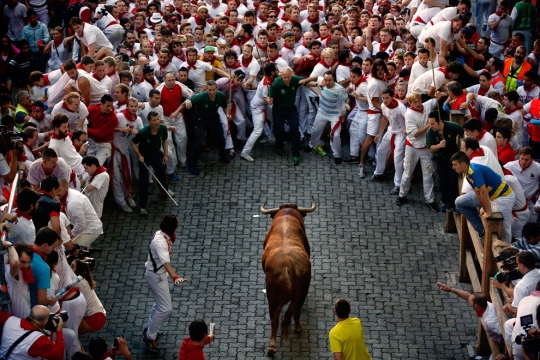
I stood and mingled with my fellow runners; waiting to run was a surprisingly pleasant and social atmosphere. Pranksters on balconies shot off rockets in an attempt to trick first time runners like myself into thinking that the bulls were coming early, but commiserating with people from all over the world helped to subside my nervousness. The cobblestone streets had been sprayed down early in the morning to clear garbage from the night before, which made them dangerously slick. I bent down to the only shoes I’d packed: flat bottomed cloth sneakers with soles like Swiss cheese. I tied them so tight that I thought I’d have to cut them off. When I got back up, I unexpectedly recognized somebody. While studying the run, I’d watched a video of a man who was nearly gored the previous year and had been interviewed after the event. Now he was standing right in front of me.
“Excuse me,” I asked. “Have you done this before?”
“This is about my 50th run,” the man replied.
“I saw your video from last year. Any pointers for a first timer?” After some deliberation he replied.
“You know what, follow me. I’ll show you how to really run with the bulls.”
“…okay.” I hesitantly agreed.
He introduced himself as Chris and I hung around with his group for the next 15 minutes or so. It was clear that they were all seasoned veterans of the run. When the time came and we were able go choose our starting position, I grabbed Chris’ shoulder and we made our way through the crowd past the open space of the town square and into the narrow, walled streets of the course. So much for my plan. On the way to our new starting spot, Chris explained what was about to happen.
“When the second rocket goes off, you’re gonna to want to run. Don’t. The bulls won’t get to our section of the course until a couple minutes after that.”
“Okay.”
“Then there’s gonna be a big group of people that will run by and you’re gonna want to run with them. Don’t. These are who the locals sarcastically call “El Valiente.” They take off way too early and won’t ever even see the bulls.”
“Okay.”
“The bulls are shorter than the crowd, so you won’t be able to see them until they’re right on you.”
“Great!” I thought to myself.
“So in order to determine where they are you have to look at the cameras in the balconies, they’re following the bulls.”
“Okay.”
“When you feel the ground tremble under the weight of the stampede, start jogging.”
“Okay…”
“And when you see the first bull, run like you’ve never run before in your life.”
“Shit. Alright.”
We got to our chosen starting position, which I would later discover is one of the more dangerous positions due to its location near a turn in the course where the bulls tend to pile up, followed by the bottle neck in which people and bulls get caught entering the stadium. Then I awaited the fateful sound of fireworks. The first rocket sailed through the air. I started stretching and adrenaline warmed my body. The second rocket echoed my pounding heartbeat. I started bouncing on my toes. My eyes dutifully leapt between the balcony cameras and watching Chris’ every movement. Finally, the cameras turned. The ground shook. Chris started running, and so did I. The next minute or so was a blur. You’d think the run is all about being fast but it’s really about staying standing. All I could focus on was using my arms to keep the mass of panicked runners from forcing me to the outside where movement would be impossible, hurdling over fallen bodies to keep from becoming one, and keeping an eye on the 2 ton monsters with swords on their heads in my left hand periphery. People and bulls alike toppled over one another causing a huge pileup on the turn before the stadium. Somehow, I was able to avoid the carnage and sprint safely through the tunnel and into the open arena. The roar of the crowd and the energy shared by the entering runners is something I’ll never forget. It was electric. I unsuccessfully searched for Chris. A giant screen replayed footage from the run, showcasing the pile up I had narrowly avoided. Chris was at the bottom of the pile. My stomach sank.
I was standing near one of the walls of the arena when the crowd around me began to desperately clear a path. Thinking a bull must be charging straight for us, I nearly leapt over the side of the corral in a single bound, but my leg got caught between the side paneling and the advancing wall of bodies. I thought my leg would break coming down on the other side, but I somehow squirmed free. I looked to see what the commotion was over. It was a little baby cow…
After the bulls are safely corralled up, calves with corked horns are released into the stadium to “play” with the runners. They charge at the participants; people who mess with the animals and then attempt to get away without being run down. As the show progresses, more cows are released and the odds of being hit increase. One guy got his belt hooked on a horn and he was dragged over ten feet through the dirt before his buddies could get him free. This goes on for about an hour and then it’s back to partying all afternoon until the bullfight that evening. Then the whole debacle starts again the next day. I stayed for a few more hours of the festival but thoughts of sleeping in the bus station again kept me from spending another night. Later that afternoon I took the last train back to Barcelona. Thus, concluded the most wildly irresponsible thing I’ve done so far.
 Wander&Wonder